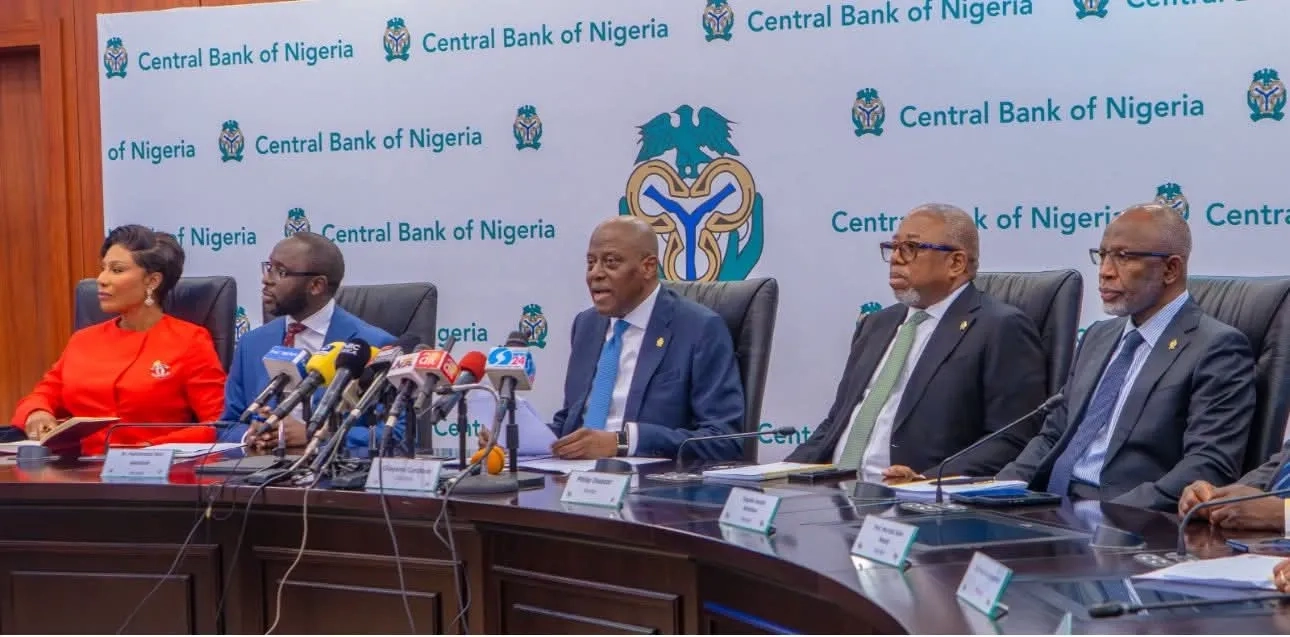
The Federal Government and the Central Bank of Nigeria have signed a Memorandum of Understanding aimed at improving coordination between fiscal and monetary policies as Nigeria works to contain inflation, manage public debt and strengthen foreign exchange stability.
The agreement was signed in Abuja on Friday by representatives of the Federal Ministry of Finance and the CBN. It establishes a framework for regular consultations, data sharing and joint analysis on key areas of economic management.
CBN Governor Olayemi Cardoso said the framework would strengthen collaboration on government cash management, debt issuance, liquidity forecasting, macroeconomic analysis and other monetary and fiscal policy matters.
He explained that fiscal and monetary policies were closely connected, noting that government decisions on spending, taxation and borrowing could affect economic activity, while monetary policy influences liquidity, interest rates and price stability.
Cardoso said the agreement was particularly important as the CBN continues its transition towards an inflation-targeting framework, which requires monetary policy to operate within a supportive fiscal environment.
Finance Minister and Coordinating Minister of the Economy, Taiwo Oyedele, said the new arrangement was intended to prevent fiscal and monetary policies from working at cross-purposes.
He stressed that the closer cooperation would not compromise the independence of the apex bank, maintaining that the CBN would retain responsibility for monetary and financial stability.
Oyedele said the Federal Government’s objective was to reduce inflation sustainably to single digits, adding that monetary policy alone could not resolve the factors driving rising prices.
He identified food production, imported costs, energy and logistics as some of the structural pressures affecting inflation. He said the government would respond through measures including strengthening grain reserves, improving agricultural yields, expanding irrigation and developing access roads to farms.
The minister also ruled out a return to fuel subsidy, arguing that reinstating the policy could put additional pressure on government finances and the naira.
Under the new framework, the Finance Ministry and the CBN are expected to improve the sharing of information on government cash positions, financing plans, credit growth and foreign exchange flows.
The CBN Deputy Governor, Corporate Services Directorate, Muhammad Abdullahi, said the arrangement would also support scenario planning, stress testing and regular technical consultations, particularly amid global economic and geopolitical uncertainties.
The Permanent Secretary of the Federal Ministry of Finance, Raymond Omachi, said the framework was designed to balance inflation control with economic growth, noting that government spending should not unnecessarily fuel inflation while monetary tightening should also avoid placing excessive pressure on economic activity and employment.