

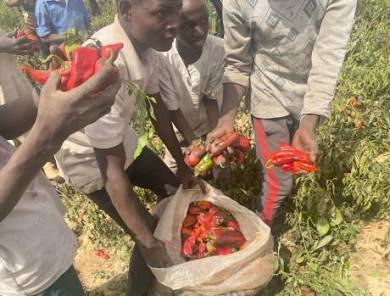
Farmers in Kano State are beginning to see new opportunities for year-round cultivation as improved irrigation facilities and rural roads offer the prospect of more reliable harvests and better livelihoods.
For Faruku Musa Haruna, a farmer in Kumfada, Garko Local Government Area, access to water has transformed the way he approaches farming. Previously, he and other farmers pooled resources to buy plastic sheets to collect and preserve water for irrigating small portions of their land.
Today, he says water flows directly into his farm without the need to operate a generator, allowing him to cultivate carrots, onions, tomatoes and peppers. He is also considering expanding into rice and wheat production.
The development forms part of an intervention involving the rehabilitation and expansion of irrigation infrastructure around Tiga Dam, Challawa Gorge Dam and Kafin Chiri Dam. The programme also includes road improvements, erosion control and agricultural support.
The Ecological Project Office, under the Office of the Secretary to the Government of the Federation, oversees the intervention, while the International Institute of Tropical Agriculture (IITA) provides technical support to farmers.
Beyond improving access to water, the initiative aims to strengthen food production, create rural employment and reduce the uncertainty associated with dependence on seasonal rainfall.
For farmers who previously struggled to maintain production during dry periods, irrigation could provide opportunities to cultivate additional crops and earn income throughout the year.
However, agricultural specialists caution that reliable water alone will not guarantee higher earnings. Farmers must also manage soil fertility, select appropriate crop varieties, control production costs and secure profitable markets for their produce.
Professor Lucky Osabuohien Omoigui, a plant breeding and genetics specialist at IITA’s Kano station, emphasised the importance of training farmers to use irrigation water efficiently and adopt sustainable farming practices.
IITA says its agricultural support covers 16 local government areas, with 1,890 beneficiaries reported across its activities. The programme includes training for 501 smallholder farmers, alongside eight farmer field schools and 86 demonstration plots.
The training focuses on water management, crop production, soil fertility and improved farming techniques. Experts also recommend rotating cereals with legumes to protect soil fertility and sustain productivity over successive planting seasons.
Infrastructure beyond the farms remains equally important. Farmers say poor roads have previously damaged produce during transportation, resulting in losses before crops reached the market.
Abdullahi Hamza, a farmer in Gana, said road improvements had made it easier to transport agricultural produce by motorcycle and car. In Kwanar-Dangora, businesswoman Hafsat Yakubu also reported improved access to her street following drainage works that had addressed flooding difficulties.
These experiences highlight the connection between agricultural production, transportation and local commerce. Even when farmers achieve better harvests, poor roads, inadequate storage and weak market access can reduce the income they ultimately receive.
Maintaining the irrigation infrastructure will also be critical. At Kafin Chiri, engineers reported progress on canal rehabilitation, while work continued on sections of the distribution network.
Officials and project stakeholders have engaged water user associations and dam managers on operations and maintenance. Sustained results will depend on keeping canals functional, distributing water fairly and ensuring that farmers at different points along the network receive adequate supplies.
The programme also faces the challenge of demonstrating lasting improvements in productivity and household income. While some farmers have reported immediate benefits, experts say the broader impact of new agricultural practices may take several seasons to assess.
For Kano’s farming communities, the promise is clear: dependable water could extend the farming calendar, create more local employment and improve food supplies.
Whether that promise translates into sustainable prosperity will depend on continued infrastructure maintenance, practical farmer education, healthy soils and reliable access to markets.