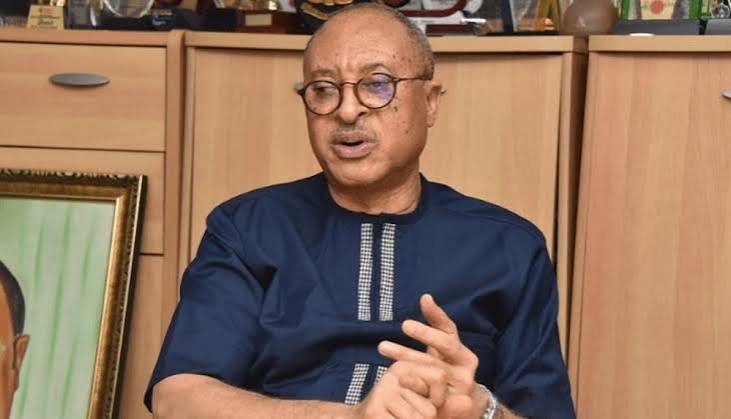
Political economist and chieftain of the Nigeria Democratic Congress (NDC), Professor Pat Utomi, has unveiled an ambitious economic target for Peter Obi’s 2027 presidential bid, saying the former Anambra State governor intends to strengthen the naira to ₦500 against the US dollar if elected.
Utomi said the proposed exchange-rate target would form part of the party’s economic manifesto, arguing that a stronger naira, alongside wider economic reforms, could help reduce inflation, tackle poverty and improve the purchasing power of Nigerians.
In a post on X on Thursday, the economist said the plan would seek to strengthen the naira from approximately ₦1,350 to ₦500 per dollar, describing the proposal as a strategy for easing the country’s cost-of-living crisis.
He argued that the anticipated appreciation of the currency would help reduce the cost of essential commodities and provide relief to households struggling with rising prices.
Utomi Projects 50 Per Cent Reduction in Food Prices
As part of the proposed economic agenda, Utomi projected that the prices of several staple foods could fall significantly if the exchange-rate target and accompanying reforms were achieved.
He estimated that a loaf of sliced bread currently selling for ₦1,750 could drop to ₦800, while a 50kg bag of imported rice priced at ₦55,000 could decline to ₦27,500.
The projections also include a reduction in the price of a medium-sized tuber of yam from ₦2,400 to ₦1,200 and a 50kg bag of maize from ₦75,000 to ₦37,500.
Other items highlighted in his proposal include plantain, chicken, eggs and garri.
According to the estimates, a bunch of plantain selling for ₦2,500 could fall to ₦1,250, while the price of a whole chicken could decline from ₦7,000 to ₦3,500.
Utomi further projected that a dozen eggs could drop from ₦2,300 to ₦1,150, while a painter of garri could fall from ₦1,300 to ₦650.
Petrol and cement were also mentioned among the commodities expected to become cheaper under the proposed economic programme.
The economist said the broader objective was to improve living conditions for Nigerians, particularly the estimated 140 million people experiencing multidimensional poverty.
Security, Electricity and Roads Included in Economic Strategy
Utomi’s proposal extends beyond the exchange rate, with investments in security, electricity and road infrastructure identified as important components of the economic plan.
He argued that improvements in these areas would help lower production and distribution costs, improve business competitiveness and make essential goods more affordable.
Insecurity has continued to disrupt farming activities in some parts of the country, while poor electricity supply and expensive transportation add to the operating costs of manufacturers, farmers and traders.
The proposed reforms are therefore intended to address some of the structural challenges contributing to high prices and weak productivity.
However, Utomi did not provide a specific timeline for achieving the ₦500-per-dollar target or fully explain the monetary and fiscal measures that would be required to sustain such an appreciation of the naira.
Economic Target Faces Questions Over Feasibility
Achieving an exchange rate of ₦500 to the dollar from around ₦1,350 would require the naira to appreciate substantially, making the proposal a major economic undertaking.
The exchange rate is influenced by several factors, including foreign exchange supply and demand, export earnings, investor confidence, inflation, monetary policy and the productive capacity of the economy.
Similarly, a stronger naira does not automatically guarantee that every commodity will become cheaper by the same proportion. Domestic production costs, transportation, energy, labour and distribution expenses also influence market prices.
The proposed figures should therefore be understood as projections under the NDC’s economic agenda, rather than guaranteed outcomes.
Utomi’s remarks add a new dimension to the economic debate ahead of the 2027 general elections, with the cost of living, food affordability and the strength of the naira expected to remain major issues for voters.
Whether the proposed targets can be achieved will depend on the policies adopted, the resources available and the ability of a future administration to deliver sustained improvements in productivity and economic stability.
#PeterObi #PatUtomi #NDC #Naira #NigerianEconomy #2027Elections #FoodPrices #OnPointGist