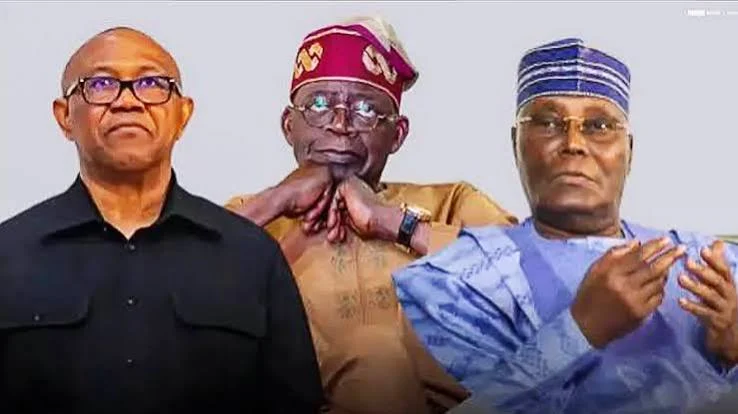
Nigeria’s 2027 presidential election is gathering momentum as President Bola Tinubu and opposition figures Atiku Abubakar, Peter Obi and Seyi Makinde intensify their campaigns, offering competing solutions to the country’s economic and security challenges.
With Nigerians grappling with the cost of living, insecurity and concerns over governance, the emerging campaign season is increasingly centred on economic recovery, fuel prices, national unity, education and the welfare of citizens.
While Tinubu is seeking a second term under the All Progressives Congress (APC), the opposition candidates are presenting alternative visions for the country’s future.
Tinubu seeks continuity
President Tinubu has urged Nigerians to renew his mandate, arguing that his administration’s policies and ongoing infrastructure projects provide a foundation for further development.
Speaking through Vice-President Kashim Shettima at an APC rally in Nasarawa State, the President called on voters to support the party’s candidates at all levels to ensure the continuation of his Renewed Hope Agenda.
He highlighted road construction, healthcare improvements and developments in education as evidence of his administration’s efforts, while promising greater security and more dividends of democracy if re-elected.
The APC has also defended the government’s education reforms, citing student loans, vocational training initiatives and increased budgetary allocations to the sector.
Atiku promises economic relief
Former Vice-President Atiku Abubakar, the presidential candidate of the African Democratic Congress (ADC), has promised to tackle insecurity, reduce economic hardship and restore fuel subsidy if elected.
During his campaign rally in Sokoto, Atiku pledged to reopen land borders to facilitate legitimate cross-border trade, particularly for communities whose livelihoods depend on commerce with neighbouring countries.
He also promised to take decisive action against insecurity to enable farmers to return safely to their farms.
Atiku urged Nigerians to participate actively in the election and protect their votes, insisting that the country needed a change in leadership.
The ADC has also proposed targeted, production-based support for qualifying petroleum products refined locally, arguing that the policy could reduce fuel, transportation and energy costs.
Makinde unveils Reset Nigeria agenda
Oyo State Governor Seyi Makinde, who is contesting under the Allied Peoples Movement (APM), has unveiled his Reset Nigeria manifesto, promising reforms across the economy, education, security and governance.
Makinde argued that economic reforms must translate into tangible improvements in people’s lives through job creation, better incomes and a lower cost of living.
He also promised a more accountable government, with measurable targets and clear timelines for evaluating performance.
On fuel pricing, the governor proposed a system that would allow Nigerians to benefit from additional revenue when crude oil prices rise above the government’s budget benchmark.
Makinde further advocated constitutional and political reforms, including a proposal that presidential candidates should secure at least 51 per cent of the votes to win, alongside broader discussions on national unity.
He said his proposed government of national unity would prioritise national interests rather than personal political ambitions.
Obi pledges security and national unity
Peter Obi, the presidential candidate of the Nigeria Democratic Congress (NDC), has promised to unite the country, confront corruption and improve education and healthcare.
Speaking at a town hall meeting in Calabar, Cross River State, Obi argued that national unity would strengthen Nigeria’s ability to tackle insecurity and other pressing challenges.
He vowed to pursue kidnappers and those responsible for attacks on schoolchildren, insisting that public funds must be used for the benefit of citizens.
Obi also promised greater investment in education and healthcare, describing both sectors as essential to national development.
However, his campaign activities in Calabar were overshadowed by an attack on his convoy by suspected hoodlums. Videos circulating online showed individuals damaging vehicles, while a media aide reported that a person sustained a gunshot injury.
Obi said his security team advised him to take another route after the attackers allegedly armed themselves with machetes and other weapons.
The incident has renewed concerns about political violence ahead of the 2027 elections.
Opposition unity and political tensions
Beyond their policy promises, the emerging presidential contest is also being shaped by questions about opposition unity, electoral credibility and the ability of rival parties to challenge the ruling APC.
Opposition figures have criticised what they describe as attempts to restrict their political activities, while insisting that Nigerians deserve a credible election and a level playing field.
The ruling party, meanwhile, maintains that Tinubu’s reforms require more time to deliver their full benefits.
As campaigns gather pace, Nigerians will be watching closely to determine which candidate offers the most convincing solutions to the country’s economic difficulties, security threats and governance challenges.
Ultimately, the contest is expected to test not only the candidates’ promises but also their ability to convince voters that they can deliver meaningful change.