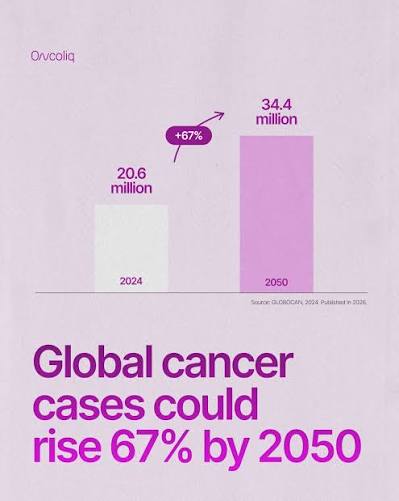
The global cancer burden is projected to increase sharply over the next 25 years, with annual new cancer cases expected to reach about 34.4 million by 2050, representing a 67 per cent increase from 2024 levels, according to the latest GLOBOCAN estimates.
The latest figures from the International Agency for Research on Cancer (IARC), the specialised cancer agency of the World Health Organisation, show that an estimated 20.6 million new cancer cases and 9.8 million cancer deaths occurred globally in 2024.
Cancer deaths could also rise sharply
The report projects that annual cancer deaths could increase to approximately 17.5 million by 2050, representing an increase of nearly 80 per cent from the 2024 figure.
Researchers say the projected increase is largely driven by population growth and ageing, although prevention and early detection remain critical to controlling the future burden of the disease.
The global population is projected to increase from about 8.2 billion in 2024 to 9.7 billion by 2050, contributing significantly to the expected rise in cancer cases.
Men and women both affected
Of the estimated 20.6 million new cancer cases recorded globally in 2024, approximately 10.6 million occurred among men, while women accounted for about 10 million cases.
Men represented approximately 56 per cent of cancer deaths, compared with 44 per cent among women.
Lung cancer remains the world’s leading cancer
The GLOBOCAN estimates identified lung cancer as the most commonly diagnosed cancer globally in 2024, with approximately 2.6 million new cases.
It was also the leading cause of cancer deaths, accounting for about 1.9 million deaths worldwide.
Other cancers with major global burdens include:
- Breast cancer
- Colorectal cancer
- Prostate cancer
- Stomach cancer
- Liver cancer
Breast cancer was the second most commonly diagnosed cancer globally, with approximately 2.4 million new cases in 2024.
Africa faces a growing challenge
The projected increase is particularly significant for lower-income countries, where cancer prevention, diagnosis and treatment services can be limited.
The GLOBOCAN analysis indicates that the largest proportional increases in cancer incidence are expected in countries with lower Human Development Index levels.
For countries such as Nigeria, the implications include the need for stronger cancer surveillance, improved screening, earlier diagnosis and greater access to treatment.
Recent GLOBOCAN-based estimates cited for Nigeria put the country’s 2024 cancer burden at approximately 152,261 new cases and 90,795 deaths, with breast, prostate and cervical cancers among the most frequently diagnosed.
Prevention could change the outlook
Despite the projected increase, researchers stress that the future cancer burden is not inevitable.
The GLOBOCAN analysis highlights the importance of prevention measures including reducing tobacco use, preventing cancer-causing infections, limiting alcohol consumption, maintaining healthy body weight and increasing physical activity.
The analysis estimates that global cancer incidence rates would need to decline by approximately 2 per cent every year to prevent the number of new cases in 2050 from exceeding the 2024 level.
Early detection remains crucial
The projected figures are renewing calls for governments and health authorities to strengthen cancer screening, diagnosis and treatment systems.
For Nigeria, experts say investment in healthcare infrastructure, cancer specialists, diagnostic facilities and access to treatment will be essential as the country’s population grows and ages.
The challenge is therefore not only about treating more cancer patients in the future but also about preventing cancers where possible and detecting them earlier when treatment is more likely to be effective.
The bigger picture
The new GLOBOCAN estimates present a warning about the scale of the global cancer challenge. While demographic changes are expected to drive much of the increase, stronger prevention, early detection and treatment programmes could significantly influence the eventual outcome.
OnPointGist will continue to bring you important health, medical and public-health developments affecting Nigerians and the global community.