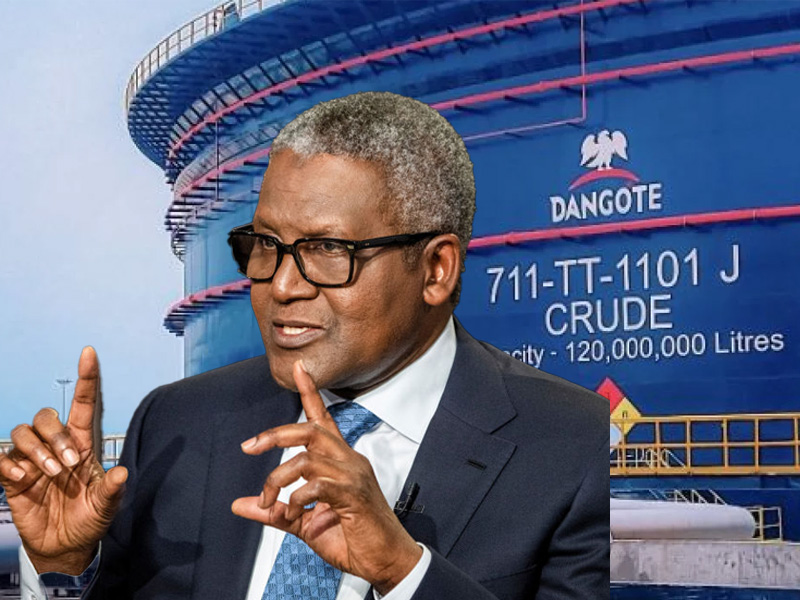
President of Dangote Group, Aliko Dangote, has explained why petrol prices in Nigeria remain high despite the commencement of large-scale domestic refining.
Speaking during an interview with Arise Television, Dangote said local refining does not completely shield Nigeria from fluctuations in international crude oil prices because refineries still have to purchase crude at prevailing market rates.
According to him, the Dangote refinery has at times paid significant premiums for crude, with the facility purchasing crude at as much as $124 per barrel in May.
He said such high feedstock costs make it difficult to substantially reduce the price of refined petroleum products.
“We can’t go now and subsidise everything,” Dangote said.
Petrol price gap encourages smuggling
Dangote also pointed to the difference between petrol prices in Nigeria and neighbouring countries as another factor affecting the domestic market.
He said petrol is about 30 to 50 per cent more expensive in some neighbouring countries, creating an incentive for traders to smuggle locally refined petrol across Nigeria’s borders for higher returns.
“There is still a lot of smuggling of the same petrol we are producing to our neighbouring countries because those neighbouring countries are about 30 per cent to 50 per cent more expensive than Nigeria,” he said.
Despite concerns over rising pump prices, Dangote assured Nigerians that his refinery would continue supplying the domestic market.
He said the refinery would maintain supply and that Nigerians should not expect shortages or queues from its end.
“Nigerians don’t need to worry. There will not be any shortage from our own part. There will not be any queues, and we’ll make sure that we keep satisfying the market despite all odds,” he said.
Dangote raises concern over high interest rates
The businessman also identified high borrowing costs as a major obstacle to Nigeria’s industrial development.
Dangote said interest rates around 30 per cent make it difficult for businesses to finance major industrial projects and attract new investments.
“It is very difficult to industrialise with interest rates at 30 percent,” he said.
He warned that without deliberate policies to protect productive domestic industries, Nigeria could struggle to attract another major refinery investment.
Dangote also cited inconsistent government policies and inadequate electricity supply as continuing challenges for manufacturers.
He argued that businesses cannot remain competitive when they are forced to rely heavily on diesel for power generation.
“You cannot manufacture goods with diesel,” he said.
Textile investment described as biggest business mistake
Reflecting on his business history, Dangote described his investment in the textile industry as his biggest business mistake.
He said the business eventually collapsed amid competition from imported products and what he described as dumping by foreign manufacturers.
“We were swamped by Chinese dumping and Indian dumping. So eventually we had to close down,” he said.
Dangote said the closure resulted in the loss of almost 8,000 jobs, including 6,920 positions at Nigerian Textile Mills in Ikeja.
He said the experience reinforced the importance of creating policies that support productive domestic industries and allow businesses to remain viable while creating jobs and generating economic activity.