
















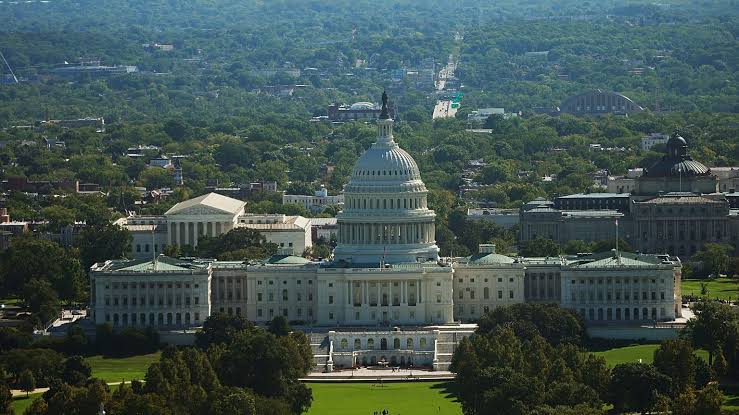
The United States House of Representatives has, for the third time, passed a War Powers Resolution seeking to halt President Donald Trump’s continued military involvement in the conflict with Iran without congressional approval.
The resolution, H. Con. Res. 93, passed by 220 votes to 204 on Tuesday, September 15, 2026. All 213 Democrats who voted supported the measure, while seven Republicans joined them. One independent voted against it.
The resolution directs the President, under Section 5(c) of the War Powers Resolution, to remove US Armed Forces from hostilities with Iran unless Congress provides the required authorisation.
The latest vote marks the third time the House has approved a similar measure since the conflict began. Previous House resolutions were passed in June and July, with votes of 215–208 and 214–208 respectively.
The measure was sponsored by Democratic Representative Seth Moulton of Massachusetts, who has argued that Congress should have a greater role in determining whether US military operations against Iran should continue.
Seven Republicans — Thomas Massie, Brian Fitzpatrick, Warren Davidson, Tom Barrett, Mariannette Miller-Meeks, Zach Nunn and Nancy Mace — joined Democrats in backing the latest resolution.
The vote came as the conflict continued to generate debate in Washington over the extent of presidential military authority and Congress’s constitutional role in authorising military action.
The Congressional Budget Office has estimated that the conflict had cost the United States at least US$38,000,000,000, with ongoing costs projected to rise by roughly US$2,000,000,000 to US$3,000,000,000 per month.
Supporters of the resolution have argued that sustained military operations require congressional authorisation, while Republicans defending the administration’s position have maintained that Iran remains a security threat and that the President has authority to respond to threats against US personnel and interests.
The resolution, however, does not automatically bring the conflict to an end. Previous measures passed by the House have not resulted in the cessation of US military operations.
The latest measure would also need to clear the Senate before it could become binding. Previous Senate efforts relating to the conflict have faced significant opposition, and the White House is expected to oppose the House resolution.
The War Powers Resolution, enacted in 1973 following the Vietnam War, was designed to establish limits on the President’s ability to commit US forces to hostilities without congressional involvement.
The latest House vote therefore represents another congressional effort to assert its role in decisions concerning the continuation of US military operations against Iran.