
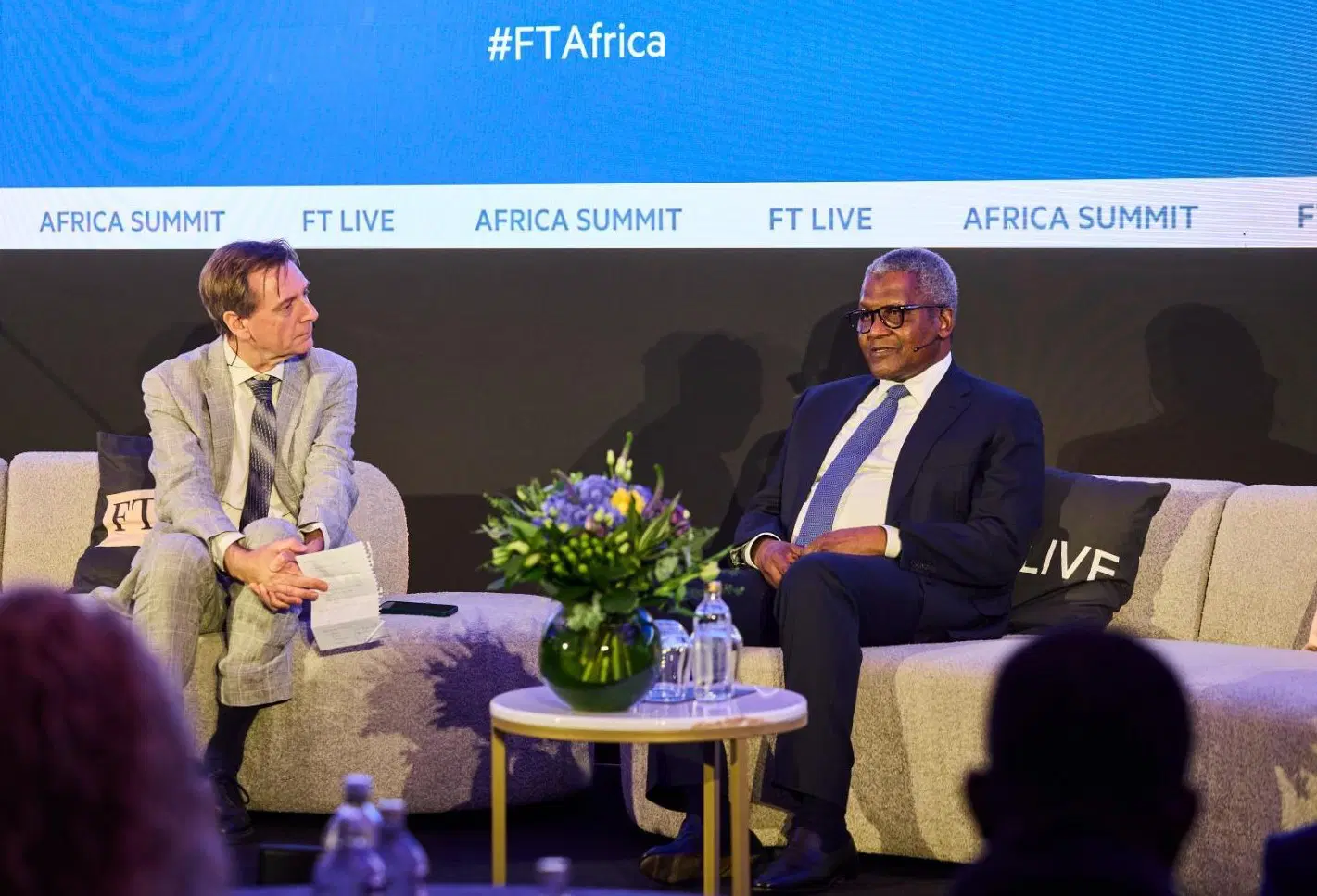
Africa’s richest man, Aliko Dangote, has unveiled an ambitious plan to build a continent-wide petroleum distribution network while calling on African governments to protect local industries from unfair foreign competition.
The President and Chief Executive of Dangote Industries Limited said the initiative would involve investments in pipelines, storage facilities and supply routes across East, Central and Southern Africa to improve access to refined petroleum products and strengthen energy security.
Speaking in an interview with Financial Times journalist David Pilling, Dangote disclosed that his group had acquired a 25 per cent stake in Kenya’s petroleum products pipeline network, with additional projects planned in other African countries.
He said the company was also developing a petroleum distribution corridor linking Djibouti and Ethiopia, featuring storage terminals and tank farms. A separate project in Cameroon is nearing completion, while Namibia is being considered a strategic hub for supplying markets across Southern Africa.
According to Dangote, products from his refinery in Lagos could be shipped to Namibia and distributed to other markets, including Botswana and South Africa. The group is also exploring supply routes extending to Zimbabwe and Zambia.
The distribution strategy complements plans to establish a refinery in Lamu, Kenya, with a projected capacity of approximately 700,000 barrels per day. Dangote said the location was selected because of its deep-water access, marine infrastructure and suitability for large-scale refining operations.
He explained that the proposed refinery would obtain crude oil from multiple sources to ensure flexibility and sustainable operations.
Beyond expanding its energy infrastructure, Dangote urged African governments to adopt stronger industrial policies that support local manufacturing, protect productive capacity and create employment opportunities.
He argued that allowing imported goods to displace locally manufactured products would weaken African businesses and undermine job creation.
“Allowing imports to displace local production means we are exporting our jobs out of the continent and importing poverty into the continent,” he said.
The billionaire also questioned why African nations should hesitate to protect their industries when major global economies employ similar measures to strengthen domestic production.
Dangote further disclosed that his group had earmarked approximately $50 billion for investments between 2026 and 2030, describing the programme as part of a broader effort to accelerate industrial development across Africa.
He identified unreliable electricity, weak financial systems and inadequate industrial policies as major obstacles to the continent’s economic growth.
Dangote stressed that dependable power supply was essential for manufacturing, mining and mineral processing, adding that Africa could unlock significant opportunities for job creation and economic diversification by addressing its infrastructure challenges.
Despite these difficulties, he expressed confidence that the continent had the natural resources, agricultural potential and youthful population needed to become a major global industrial force.
He said the goal was not merely to expand his business empire but also to demonstrate that African companies could deliver large-scale projects capable of transforming the continent’s economy.