








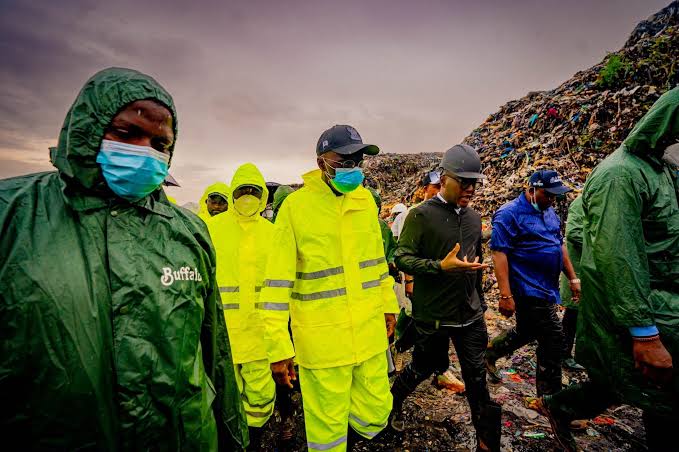
Lagos State Governor, Babajide Sanwo-Olu, has declared a state of emergency on waste collection across the state following mounting refuse accumulation and delays in evacuating waste from several parts of the metropolis.
Sanwo-Olu announced the emergency measures on Wednesday during an inspection of the Olusosun dumpsite in Ojota, where he assessed the challenges affecting waste disposal and collection operations.
The governor, accompanied by his deputy, Obafemi Hamzat, also met with stakeholders in the waste management sector to review the situation and agree on immediate, medium and long-term measures to restore efficient waste collection across Lagos.
Sanwo-Olu acknowledged that waste collection had slowed considerably in different parts of the state in recent weeks, resulting in mounting refuse and residents resorting to indiscriminate dumping in some locations.
He attributed part of the problem to the inability of some Private Sector Participation operators to meet their contractual obligations, saying the government had moved to intervene before the situation worsened.
The governor said the state was responding to the crisis with measures designed to increase the capacity of disposal sites and improve the turnaround time for waste trucks.
He explained that compaction activities were already taking place simultaneously at the Olusosun and Solous 3 dumpsites, with the aim of creating more space and allowing waste collection vehicles to discharge their loads more quickly.
The Lagos State Government is also expected to deploy additional waste-compactor trucks as part of the emergency response. Reports indicate that 160 trucks are to be added to the state’s waste management fleet, while four disposal sites are expected to be reopened to ease congestion at the major dumpsites.
The latest crisis is not entirely new.
Lagos had faced similar difficulties earlier in the year, with congestion and long queues at disposal facilities, particularly Olusosun, slowing down the evacuation of waste from different parts of the state. The government had subsequently ordered intensified evacuation operations and additional resources to clear accumulated refuse.
The pressure has also exposed weaknesses within the state’s waste collection structure. Lagos has hundreds of PSP operators responsible for collecting waste from homes and businesses, but the Deputy Governor, Hamzat, previously acknowledged challenges involving the capacity and performance of some operators.
Meanwhile, the government has continued to intensify enforcement against residents who dump refuse illegally.
The Lagos Waste Management Authority recently arrested a resident in Meiran for allegedly dumping waste into a drainage channel during rainfall, while the agency has also sealed businesses accused of indiscriminate disposal.
The enforcement drive reflects the government’s argument that resolving the waste crisis requires cooperation from both service providers and residents. While authorities are under pressure to improve collection and disposal, residents are also being warned against dumping refuse on roads, medians and drainage channels.
For Sanwo-Olu, the immediate priority is to restore normal waste collection and prevent the accumulation of refuse from becoming a broader environmental and public-health crisis.
The governor’s declaration of a state of emergency therefore places the waste management system under heightened government attention, with the effectiveness of the intervention likely to be measured by how quickly refuse is cleared from affected communities and whether the bottlenecks at disposal sites are permanently reduced.
With additional trucks, expanded disposal capacity and tighter enforcement expected to form part of the response, Lagos is now under pressure to turn the emergency declaration into visible improvements in waste collection across the city.