
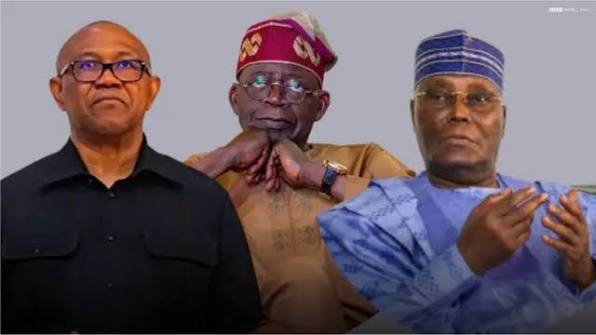
As Nigeria moves closer to the 2027 presidential election, major political contenders are presenting competing ideas on how to address the country’s economic difficulties, insecurity and social challenges.
From cheaper fuel and millions of new jobs to improved electricity, free education, stronger healthcare and enhanced security, the promises coming from the various campaigns are growing more ambitious.
But beyond the attractive proposals lies a critical question: how much will these programmes cost, where will the money come from, and how will the next government deliver on them?
So far, several candidates have outlined policy priorities without providing detailed cost estimates, funding plans, implementation schedules or specific benchmarks that would allow voters to measure their performance.
Tinubu: Continue with the reforms
President Bola Tinubu, who is seeking another term on the platform of the All Progressives Congress, is presenting the election as a choice between continuity and a return to previous policies.
Tinubu has defended his administration’s removal of fuel subsidies and foreign-exchange reforms, arguing that the measures were necessary to address longstanding economic weaknesses.
The President has pointed to improvements in foreign reserves, the naira and government revenue as evidence that the reforms are beginning to produce results.
His campaign is also highlighting investments in roads, airports, seaports, irrigation and other infrastructure, alongside plans to further reform the electricity sector.
On security, Tinubu has backed constitutional changes that would permit the creation of state police, arguing that decentralised policing could strengthen the country’s response to insecurity.
However, the administration faces the challenge of convincing Nigerians who continue to struggle with high living costs that the immediate hardship associated with its reforms will eventually translate into better living conditions.
The central question for Tinubu’s campaign is therefore whether voters will consider the longer-term benefits of the reforms sufficient reason to maintain the current direction.
Atiku: Reverse some policies
Former Vice President Atiku Abubakar is offering voters a different approach.
The African Democratic Congress candidate has identified security, education, the economy, healthcare and equitable political representation among his major priorities.
One of his most notable proposals is the restoration of fuel subsidies if elected President.
Atiku has argued that Nigerians have not received adequate benefits from the removal of the subsidy and has linked the policy to the rising cost of living.
His campaign has also promised stronger recruitment, training and equipment for security agencies, alongside improvements in education and healthcare.
But restoring the subsidy would require substantial government funding, creating questions about how the policy would be financed while the proposed administration also pursues other expensive programmes.
The challenge for Atiku will therefore be to demonstrate that his promises can be accommodated within a sustainable fiscal framework.
Obi: Shift from consumption to production
Peter Obi’s campaign is placing greater emphasis on transforming Nigeria from a consumption-driven economy into a productive one.
The former Anambra State governor has repeatedly argued that the country must increase agricultural output, expand manufacturing, develop agro-processing and create an environment where businesses can invest and generate employment.
His economic proposal includes better farm security, irrigation, rural infrastructure, storage facilities, access to finance and stronger markets for farmers.
He has also stressed the need to process more of Nigeria’s raw materials locally and increase exports of finished products.
Another major element of Obi’s programme is regional economic development, with the argument that every part of Nigeria should contribute to production and benefit from economic growth.
His approach, however, will face the test of implementation: voters will want to know the precise targets, timelines and institutional arrangements required to turn the production agenda into measurable results.
Adebayo: Make employment the priority
Social Democratic Party candidate Adewole Adebayo has placed job creation at the centre of his economic programme.
His campaign has proposed creating up to 30 million jobs through agriculture, manufacturing, digital innovation and entrepreneurship.
He has also promised to tackle the country’s out-of-school population and expand skills development, while proposing major investments in electricity generation.
His long-term electricity target is particularly ambitious, with a vision of between 50,000MW and 75,000MW by 2050.
Adebayo has also advocated greater decentralisation of production and a more organised approach to mining.
The major challenge, however, is establishing how these long-term objectives would translate into measurable achievements within a four-year presidential term.
Sowore: Education at the centre
African Action Congress candidate Omoyele Sowore has made education the foundation of his proposed transformation agenda.
His education plan includes free public education from early childhood through university, support for students in public tertiary institutions and the establishment of community colleges across local government areas.
He also proposes greater use of technology in schools through improved internet access, digital classrooms, virtual laboratories and online libraries.
Sowore’s programme further includes coding, robotics and automation in education, as well as improved remuneration and welfare for teachers.
The proposal is built on the argument that Nigeria’s long-term economic progress depends heavily on developing its human capital.
As with the other candidates, however, the financing of such an expansive programme remains an important issue for voters to consider.
Similar problems, different solutions
Despite their political differences, the leading candidates appear to agree on many of the problems confronting Nigeria.
Security, electricity, unemployment, education, healthcare and weak productive capacity feature prominently across their programmes.
The major differences lie in how each candidate proposes to address those challenges.
Tinubu is advocating continuity with his administration’s reforms. Atiku wants to reverse some of those policies, particularly fuel subsidy removal. Obi is emphasising production and investment, while Adebayo is placing employment at the centre of his economic strategy. Sowore, meanwhile, sees education and technology as critical drivers of transformation.
Nigerians need more than promises
As the 2027 campaign gathers momentum, voters will increasingly need more than broad policy statements.
Candidates must explain how much their programmes will cost, how they intend to finance them, which institutions will implement them and what results Nigerians should expect within specific periods.
Questions about revenue, borrowing, legislation and accountability will become increasingly important as the campaigns unfold.
For ordinary Nigerians, the value of any manifesto will ultimately be measured by its effect on everyday life.
Lower fuel costs must translate into relief for households. New jobs must provide genuine opportunities for young people. Electricity promises must reduce dependence on generators. Education reforms must produce better schools and stronger learning outcomes.
The 2027 election is therefore shaping up to be more than a contest over political personalities. It will also be a test of competing economic and social visions for Nigeria.
The candidate who can combine ambitious ideas with credible financing, realistic timelines and effective implementation may ultimately have the strongest argument before the electorate.