
Africa’s richest industrialist, Aliko Dangote, has unveiled plans to establish an extensive petroleum distribution network across Africa, combining investments in pipelines, storage facilities and strategic supply routes to improve access to refined petroleum products.
The initiative is expected to connect markets across East, Central and Southern Africa, helping to reduce supply bottlenecks and strengthen the continent’s energy security.
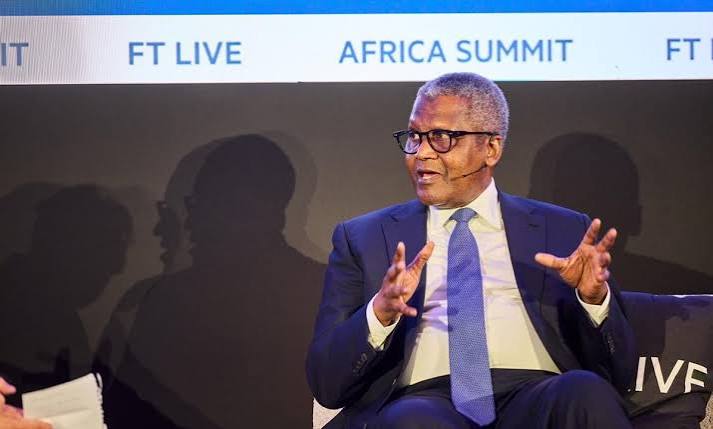
Dangote disclosed the expansion plans during an interview with Financial Times Africa Editor, David Pilling, at the Financial Times Africa Summit in London.
As part of the strategy, Dangote revealed that his group had acquired a 25 per cent stake in Kenya’s petroleum pipeline network, marking a significant step towards expanding its influence in Africa’s energy transportation and distribution sector.
The company is also pursuing projects linking Djibouti with Ethiopia, alongside investments in Cameroon and Namibia.
Kenya Pipeline Deal Opens New Opportunities
Dangote said the investment in Kenya was part of a broader strategy to establish an interconnected system capable of transporting refined petroleum products to countries that depend heavily on imports.
The group’s expansion plans include developing storage facilities and distribution corridors to improve the movement of fuel across national borders.
In East Africa, the proposed infrastructure linking Djibouti to Ethiopia is expected to support fuel storage and distribution, while a project in Cameroon is reportedly nearing completion.
Namibia has also been identified as a strategic gateway to Southern African markets because of its relatively short maritime connection to the Dangote Petroleum Refinery in Lagos.
Dangote said refined products could be transported from Nigeria to Namibia and subsequently distributed to other markets, including Botswana and South Africa. The group is also considering supply routes extending into Zimbabwe and Zambia.
Plans for a Second Major Refinery
Beyond distribution infrastructure, Dangote outlined plans for another refinery in Lamu, Kenya, with a proposed processing capacity of approximately 700,000 barrels per day.
He said East Africa’s expanding industrial and mining sectors, alongside rising demand for petroleum products, made the region an attractive destination for major energy investments.
According to Dangote, the proposed refinery would source crude oil from multiple markets rather than depend exclusively on supplies from Kenya or Uganda.
He also highlighted the importance of deep-water access, marine infrastructure and adequate water resources in selecting Lamu as the preferred location.
The proposed project would complement the group’s existing refining operations in Nigeria and support its ambitions to expand across the continent.
Dangote Urges African Governments to Protect Local Industries
Alongside the investment announcement, Dangote called on African governments to adopt policies that protect domestic industries from unfair foreign competition.
He argued that excessive dependence on imported products undermines local manufacturing, weakens industrial development and deprives African countries of employment opportunities.
Dangote maintained that governments should support their domestic producers while promoting trade and economic cooperation within Africa.
He questioned why African nations should hesitate to protect their industries when major economies, including the United States, have adopted policies designed to strengthen local manufacturing.
According to him, allowing foreign products to displace locally manufactured goods risks exporting jobs and deepening poverty across the continent.
However, his position also highlights the challenge facing African governments of protecting emerging industries without creating excessive barriers that could undermine competition and regional trade.
$50 Billion Investment Plan
Dangote further disclosed that his group had earmarked approximately $50 billion for investments between 2026 and 2030.
The investment programme is intended to expand the conglomerate’s industrial operations and demonstrate Africa’s capacity to execute large-scale projects.
He identified unreliable electricity supply as one of the major obstacles to industrialization, particularly in mining and mineral processing, where inadequate power prevents countries from adding value to their natural resources before export.
Dangote argued that stronger infrastructure, effective industrial policies and improved access to electricity would help African countries expand manufacturing, create jobs and reduce dependence on imported goods.
He also stressed the need for stronger financial institutions and greater participation by African investors in the continent’s development.
A Push Towards African Industrialization
The proposed petroleum distribution network represents an ambitious effort to connect refining capacity with markets across several African regions.
If successfully implemented, the infrastructure could improve fuel logistics, support regional trade and create new opportunities for industrial investment.
However, its long-term impact will depend on project execution, cross-border cooperation, regulatory arrangements and the ability of participating countries to address infrastructure and financing challenges.
Dangote’s broader message is that Africa must do more than export raw materials and import finished products. By strengthening local manufacturing and investing in strategic infrastructure, he believes the continent can retain more economic value and create sustainable employment for its growing population.
#AlikoDangote #DangoteGroup #AfricanIndustrialisation #Petroleum #EnergySecurity #AfricaBusiness #Kenya #NigeriaNews #OnPointGist