













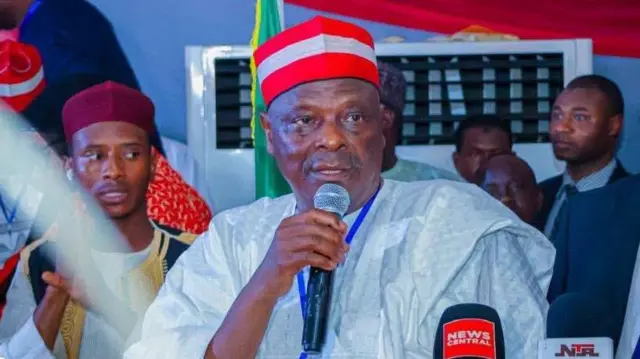
The African Democratic Congress (ADC) says it does not need a broad opposition coalition to defeat President Bola Ahmed Tinubu in the 2027 presidential election.
The party’s National Publicity Secretary, Bolaji Abdullahi, said the ADC has become strong enough to contest the election independently, although it remains open to cooperation with other opposition groups.
Abdullahi made the position known during a television interview while discussing the party’s preparations for the 2027 election.
ADC confident of victory
According to Abdullahi, the opposition coalition discussions initially began on the assumption that bringing several political forces together would make it easier to challenge the ruling All Progressives Congress.
He said the political situation has since changed following the movement of some prominent opposition figures to other political platforms.
Despite this, he insisted that the ADC does not depend on a coalition to win.
The party, he said, would welcome a broad alliance if one eventually emerges, but such an arrangement is not a condition for the ADC to compete successfully.
Obi and Kwankwaso move to another platform
Abdullahi also pointed to the emergence of Peter Obi and Rabiu Musa Kwankwaso on the National Democratic Congress platform as one of the major changes to the opposition landscape.
Obi, who was a major figure in the earlier coalition discussions, has moved to the NDC, with Kwankwaso serving as his running mate, according to the report.
The development has altered the calculations among opposition parties ahead of the 2027 presidential contest.
Opposition parties still talking
Although the ADC says it does not require a coalition, Abdullahi confirmed that discussions among opposition parties are continuing.
However, he said the focus has shifted away from simply producing a single opposition presidential candidate.
Instead, opposition parties are discussing areas where they could work together before and during the election.
One area being considered is the creation of a common system for election monitoring and vote protection.
According to Abdullahi, cooperation in protecting votes could be particularly important during the 2027 election.
What the development means for 2027
The ADC’s position adds another layer to the increasingly competitive political calculations ahead of Nigeria’s 2027 presidential election.
While some opposition figures have continued to explore cooperation, the ADC appears determined to build its own electoral strength while keeping the door open for strategic collaboration.
For the ruling APC, the emergence of several opposition movements could create a more complicated electoral environment, particularly if opposition parties succeed in mobilising voters independently across different parts of the country.
The 2027 contest is therefore shaping up around two competing possibilities: opposition cooperation or a multi-party presidential race in which several major candidates compete separately.
For now, the ADC says it is prepared for either scenario.
The road to 2027
With political realignments continuing, the strength of individual parties, the popularity of presidential candidates and the ability to mobilise voters will become increasingly important as Nigeria moves closer to the 2027 general election.
The final shape of the opposition landscape remains uncertain, and further alliances or political movements could still emerge before the election.
OnPointGist will continue to track the major political developments and realignments ahead of Nigeria’s 2027 elections.